Home to ethnic Sodgians, Turks, and Uzbeks, Qarshi was an important economic center. Each ethnicity has a different name for the city, but the now-accepted name Qarshi is the Mongolian Uzbek word for “fort.” Qarshi’s central location in a fertile oasis along the caravan route from Bukhara to Balkh allowed it to become a major trading, economic, and agricultural site.
The Mongols had interaction with Qarshi very early on. Genghis Khan enjoyed the region so much that he made it his summer pasture. When the Mongol Empire divided into the four sub khanates, Qarshi was included in the central Chaggatai Khanate. Two Chaggatai rulers, Kebek and Qazan, built palaces on their ancestor Genghis Khan’s summer pasture. Later, Timur Leng would also build a fortified castle, complete with moats, in southern Qarshi. Since Qarshi is located near Timur Leng’s birthplace and capital of Samarkand, it rose in importance during the fourteenth century. The city’s economic and agricultural import enriched Timur’s empire.
Qarshi is most well-known as the seat of the Crown Prince of the Emirate of Bukhara. During the 18th century, well after Mongol rule, The Khanate or Emirate of Bukhara occupied Transoxania in South-Central Asia. During this time, the city grew to include a set of double-fortified walls, ten caravan stops, and four Islamic madrassah schools. By the end of the nineteenth century, the Emirate of Bukhara was annexed by Russia. The resulting treaty that made Bukhara a Russian protectorate was signed in Qarshi in 1873.
Today, Qarshi is located in Uzbekistan. An irrigation project diverting water from the Amu Darya, or Oxus, River in Turkmenistan into Uzbekistan brings water to the area surrounding Qarshi. This region is now planted with cotton crops, the economic staple of the city today.
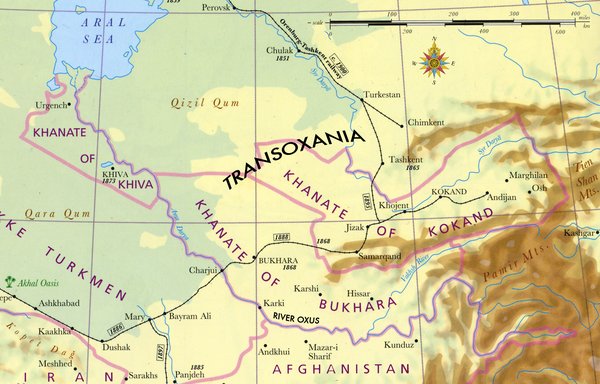
Map of the Khanate of Bukhara. Qarshi here is spelled “Karshi.”
